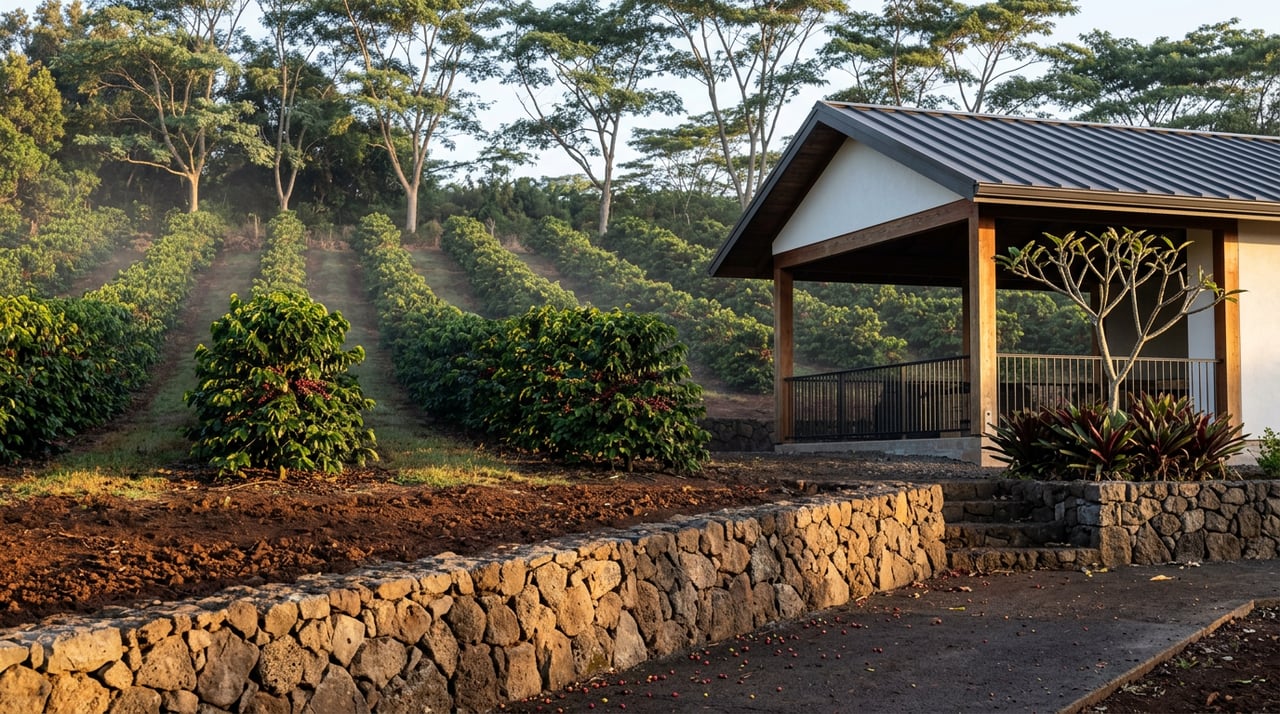
Picture two coffee parcels on the market above Kainaliu and Holualoa this month, priced within a few thousand dollars of each other, both roughly three sloped acres of mature trees sitting in the same elevation band. On paper they read like the same purchase. They are not. One conveys fee simple, meaning the buyer owns the dirt outright. The other sits on a Kamehameha Schools Bishop Estate agricultural lease, and the price you pay today is only half the math. The other half shows up the day you try to sell, and it depends entirely on which year of the lease term you happen to be standing in.
Most buyers shopping the Kona coffee belt spend their due diligence budget on the wrong worry first. They ask about the volcano. They should be asking about the lease.
The Worry Everyone Starts With
Hawaii Island real estate carries a reputation, fairly earned in some districts, for volcanic risk that scares off financing and inflates insurance premiums. The USGS lava hazard zone system runs from Zone 1, the highest risk, down to Zone 9, the lowest, and it shapes what a lender will approve and what a carrier will write.
The working Kona coffee belt, the slopes of Hualalai above Kailua-Kona, sits in Zone 4. That zone carries a moderate hazard rating with standard insurance availability and normal underwriting guidelines. Property values in Zone 4 are not discounted for volcanic risk the way they are in Zones 1 and 2, where FHA financing is unavailable and conventional lenders that do write loans typically ask for at least 20 percent down. Buyers priced out of standard coverage in those lower zones often end up with the Hawaii Property Insurance Association, the state's insurer of last resort, which caps dwelling coverage at $450,000.
None of that applies to a working coffee farm in Holualoa, Kainaliu, Honaunau, or Hookena. Hualalai last produced a flow in 1801, the one that shaped the coastline near Kona's airport, and it erupts far less often than Kilauea or Mauna Loa. The USGS monitors it continuously, and Zone 4 financing and insurance look, for most practical purposes, like financing and insurance anywhere else in the state.
So if the volcano isn't the thing that trips up a Kona coffee farm purchase, what is?
The Paperwork That Actually Sets Your Exit Price
A meaningful share of the best-situated coffee ground in the Kona belt was never sold outright. It was leased. Kamehameha Schools Bishop Estate has long been one of the largest landholders in this district, and in recent years it has issued new 35-year agricultural leases across North and South Kona to replace older terms. These new leases read nothing like the ones they replaced.
The rent schedule differs by district, with North Kona leases running higher than South Kona leases. But the number that actually changes your investment math is the assignment fee, the cut the landowner takes if you sell before the lease term ends. Sell during the first ten-year period and the fee runs 30 percent of your sale price, whether or not you're selling at a loss. Sell during the second decade and it drops to 20 percent. By the third decade it falls to 10 percent. The lease also reserves the landowner's right to reclaim a portion of the acreage for a higher and better use.
That timing detail matters more than the sticker price. A parcel entering year one of its lease term and a parcel entering year 22 can carry an identical asking price and represent two completely different holding periods before a sale stops handing away a third of your proceeds.
There's a second friction buried in the same paperwork. Hawaii law requires that a seller of residential leasehold property hand the buyer a copy of the lease and all its amendments, along with a leasehold disclosure statement prepared by an attorney, within ten days of opening escrow, and the buyer can walk away if the terms don't work. That protection exists for residential leases. It does not extend to agricultural leases, even when a farmhouse sits on the land.
| Fee Simple | KSBE Agricultural Lease | |
|---|---|---|
| Ownership | Buyer owns land outright | Land reverts to lessor at term end |
| Assignment fee on resale | None | 30% (years 1-10), 20% (years 11-20), 10% (years 21+) |
| State leasehold disclosure protection | Not applicable | Does not apply, even with a residence on site |
| Landowner's reclamation right | None | Portion may be reclaimed for higher and better use |
Before you fall for a price per acre, ask which column you're actually buying into, and where in the lease term the clock currently sits.
Water Decides More Than the Brochure Admits
Once the tenure question is settled, the next variable that moves both livability and resale value is water source, and it splits three ways across the belt.
- County-served parcels, connected to the Department of Water Supply, carry a real premium over comparable land nearby.
- Catchment-only parcels rely on rainwater collected into a cistern, a system that works well in wetter Hamakua and Puna but runs tight in the drier Kona and Kohala corridors.
- Well-served parcels, more common in upper Kohala than in Kona proper, require periodic testing to confirm the source stays usable.
Two neighboring parcels at the same elevation, same acreage, same asking price, can carry entirely different water infrastructure, and that difference follows the property through every future sale, not just this one.
The Tax Status You Inherit, Not Apply For
Hawaii County offers a dedicated-agriculture property tax classification that significantly reduces the tax bill on land actively used for farming. The detail buyers miss is timing. Inheriting that status as part of a purchase, because the current owner already holds it, is far easier than applying for it fresh after closing.
If a listing doesn't mention dedicated-Ag status, ask directly whether the classification exists today and whether it survives the sale. That single question can be the difference between a manageable annual tax bill and a much larger one, and it's not something a listing photo will ever show you.
Zoning carries its own quiet consequence for anyone hoping to subdivide later. Hawaii County uses designations like Ag-1, Ag-3, Ag-5, and Ag-20, where the number sets the minimum lot size in acres. A five-acre parcel inside an Ag-20 zone cannot be split, while a 40-acre parcel inside Ag-5 could theoretically become eight parcels. Verify current zoning and subdivision history with the County Planning Department before you build any plan around future subdivision potential.
What the Acreage on Title Doesn't Tell You
Coffee grows best between roughly 750 and 2,500 feet of elevation, and many longtime growers in the belt hold the view that higher slopes produce a better bean thanks to the climate at that altitude. But the acreage on the title rarely matches the acreage you can actually plant. Small Kona coffee properties commonly run 1 to 10 acres, with many smallholder operations sitting at the 1 to 5 acre end, and steep slopes, lava rock, and gulches routinely eat into what's usable. Ask for a walk of the property, not just a survey, before you assume every acre on paper is an acre you can farm.
If your plan includes marketing your own harvest under an estate label, confirm the origin labeling requirements before you build a business plan around them. And if the farmhouse on the parcel is older, check whether it still runs on a cesspool. Act 125, passed in 2017, requires the replacement of every cesspool in Hawaii by 2050, and the Department of Health counts roughly 88,000 statewide with nearly 50,000 on the Big Island alone, sorted into priority tiers by contamination risk. That's a cost a buyer should price into the offer, not discover after closing.
The Question Worth Asking First
None of this means a Kona coffee farm is a bad purchase. It means the diligence that matters most isn't the one most buyers start with. The volcano is the least of it. The lease term, the water source, the tax status, and the cesspool clock are the four things that actually decide whether the parcel you're buying performs the way the listing implies.
A Few Questions Buyers Ask Early
Can I get a mortgage on a KSBE agricultural leasehold parcel? Lenders evaluate agricultural leasehold differently than fee simple, and terms vary by lender and by how much time remains on the lease. Confirm financing eligibility for the specific parcel and lease term before you write an offer.
Does the assignment fee apply even if I'm not making a profit? Yes. The fee schedule is calculated on the sale price, not on your gain, so a seller taking a loss still owes the fee under the same tiered schedule.
Is Zone 4 really as low-risk as fee simple land elsewhere on the island? Zone 4 carries standard insurance availability and normal lending terms, which is meaningfully different from Zones 1 and 2. It still reflects an active volcanic system, so any buyer should review current USGS guidance for the specific parcel before assuming risk is identical to a non-volcanic market.
Coffee country rewards patience and punishes assumptions, and the parcels that look most alike on a spec sheet are often the ones with the most different paperwork underneath. If you're comparing fee simple and leasehold coffee ground in the same breath, that comparison is exactly the kind of groundwork Cheree Rapozo walks Kona buyers through before an offer goes in, not after.
E Komo Mai. Let's find your Hawai'i home.